

 |
|
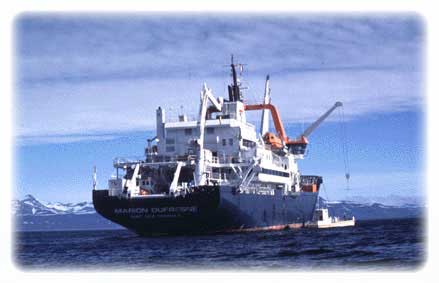
| The Marion Dufresne - click the ship for more information |
IFRTP
- click the logo for more information
|
A typical 2 months cruise covers 10 000 miles and obtain more than 100 cores between 20 and 55 m length. The ship (vessel length: 120.5 m, 15 knots cruising speed, Thomson-Marconi 3D bottom mapping, 3.5 khz digital multi-beam seismic, large laboratory space and container availability, capacity for 50 scientists, large bar with good French wines; routine coring length 30-50 m in 4 hours at 3000 m water depth; 58m longest core yet achieved) is based in Reunion (Indian Ocean) and its main role is support to the French Islands in the Southern Indian Ocean (Kerguelen, Amsterdam, Crozet). The ship is available several months per year (mostly between March and October) for oceanographic research, under responsibility and funding of the French Polar Institute (IFRTP).
International cruises may be mounted, in particular for IMAGES, on a shared cost basis. The reference price for the ship is 250 kFF/day including coring and steaming time to and from La Reunion Island at 15 knots. Each station needs 6 hours if no detailed 3D mapping is necessary. Typically, the 2 month cruise cited above will cost 15 MFF (2.5 M US$).
Five major participants may share that cost for 0.5 M US$ each, and each get about 20 giant cores in exchange. Or 5 minor participants may associate to replace one of the major participant, and get each about 4 giant cores for 100 k$. All costs evolve with the total length of the cruise from and back to Reunion. A significant part of the cost may be covered by France if French projects are reviewed favourably according to procedures set by IFRTP. However, the whole cruise is under scientific responsibility of IMAGES, with shared common goals and formal engagement of collaborative work on the cores.
Decisions to participate in the cruise engage fully each participant (cruise cost MUST be MET), and each participant will benefit or lose in proportion of the funding share if cruise result exceeds or is below what was expected during planning.
When research teams or organisations are interested to mount or participate to an IMAGES cruise, an initial project is submitted to the IMAGES Scientific Committee either to the Office directly or through the national representative.
If the project is accepted as an IMAGES action, proposals from other countries and agencies, in the same general area, will be encouraged for sharing cost of the cruise and developing scientific collaboration. The project should rapidly evolve as a proposal for establishing an IMAGES Working Group (WG).Typical format for the proposal is one page, with scientific rationale, location, proposed leader and members. These proposals are discussed and approved, amended or rejected during IMAGES Scientific Committee meetings (once or twice a year). The WG will be in charge of the long term preparation of the cruise of which the meetings are at least partly funded by IMAGES. As the proposal matures in a formal program, action will become driven by the SciCom planning groups. The whole process takes at least two years.
Final decisions for the cruise realisation, format, and timing, are taken by IFRTP (on grounds of science and available funds) before the end of the year prior to the cruise.
A planning group is created each year (n) by the Scientific Committee for the planning and co-ordination of the international oceanographic coring cruises for the following year (n+1). A planning group chair is nominated by the Scientific Committee. He or she will be ex-officio member of the Executive Committee for the years n and n+1.
* Nick Pisias,
planning group chair 1999-2001 - pisias@oce.orst.edua, M.L.Machain Castillo,
assistant planning group chair 1999-2000 -
machain@mar.icmyl.unam.mx
* E. Jansen, planning group chair - 1998-1999 - jansen@uib.no